Month: April 2020

  • Introducing Building Blocks: Orientation and Mapping Pre-existing Knowledge

    Introducing Building Blocks: Orientation and Mapping Pre-existing Knowledge

    LessonApp provides pedagogically meaningful lesson structure that is based on the building blocks. Each building block represents a phase or a function of a lesson. LessonApp users can plan lessons by using building blocks according to the objective of learning. The building blocks are:

    1. Grouping and warm-up
    2. Orientation and mapping pre-existing knowledge
    3. Acquiring new information
    4. Practicing and activating students
    5. Reflection
    In this blog we will introduce the second building block: orientation and mapping pre-existing knowledge.

    Orientation helps students to understand what is the topic of the lesson or the course. The purpose of orientation is to prepare students’ minds for receiving and processing new information. Orientation also raises interest and motivation towards the topic and new knowledge to be learned.

    The objective of mapping pre-existing notions and knowledge is to activate prior knowledge and to focus the student’s thoughts on the subject being taught. Students do not come into the learning situations as blank slates (“tabula rasa”). They have pre-existing knowledge, beliefs, perceptions and attitudes related to the subject and topic. According to David Ausubel, an American psychologist, the most significant thing from the learning perspective is what the student already knows, or at least think they know, about the subject being learned.

    Both orientation and mapping pre-existing notions and knowledge promote learning. Orientation and mapping students’ prior knowledge help students make the connections between their pre-existing notions and the new knowledge. New information is easier to understand and it becomes relevant to learners when students are able to relate it to their existing knowledge. Therefore, it is justified to call orientation and mapping prior knowledge “boosters of learning”!

    For orientation, students can be given a new theme to work with, or a problem or claim related to that theme. Orientation tasks can be written presentations, charts, pictures, concept maps etc. Also, teacher’s introduction, a short story or a case example can work as an orientation for the following theme.

    There are several useful methods for mapping students’ pre-existing notions and knowledge: admit slips, advanced organizer, building the knowledge base, entry test, pair or group discussion, inside-outside circles, concept map and so on. All these and much more you’ll find in LessonApp!

    Students can work on their orientation and pre-existing notions and knowledge mapping exercises either alone, in pairs or in small groups. The exercises can also be carried out online and as part of distance teaching.

    You will find versatile methods for orientation and mapping pre-existing knowledge on LessonApp.

  • Coming soon to Premium

    Coming soon to Premium

    Basic version on LessonApp is free and it has all basic features. Buying a Premium license you will get many more new features, libraries and tools to use. Here are some examples of new features coming to LessonApp Premium.

    Self-assessment tool and certificate

    Self-assessment tool for teachers to develop themselves and to acknowledge their professional development is up and running soon! Here are some sneak peaks:

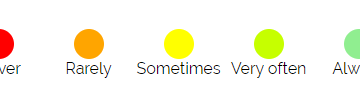
    Teacher has a color-coded scale to choose from:

    There are questions to guide teacher’s evaluation and they will choose a best option from the scale:

    Tool suggests concrete areas for improvement:

    And when time goes by and teacher has planned more lessons, the self-assesment tool will ask couple of more questions and show the improvement. After the teacher has completed all of the assesments, they will get a certificate of completion.

    Distance teaching

    How to support teachers with pedagogy suitable for Distance Teaching and inspire students who are learning at home during lockdown. What activating methods could you use when distance teaching? How to activate students via software? Tips and practices coming to help teacher’s work during this unforeseen time. Example lesson plans will give ideas how to turn monotonous and boring sessions to fascinating learning journeys.

    Localised language versions

    With the help of our dear partners we are developing language versions of LessonApp for the following languages:

    • Burmese
    • Spanish
    • Portugese
    • Romanian

    These versions contain the same set of materials as the original LessonApp in English with a localy tested twist.

  • 6th lesson for 2020: Mathematics lesson for 8th graders: Direct and inverse proportions

    6th lesson for 2020: Mathematics lesson for 8th graders: Direct and inverse proportions

    Author: Tommi Roininen (M.Sc.), Assistant principal, Hakkari lower secondary school (grades 7–9), Lempäälä, Finland

    This lesson was held after the schools moved to distance teaching in Finland. To be honest, it really has been amazing to see how quickly and smoothly our school system has adapted to the current situation. Luckily my students were already familiar with ‘Flipped learning’ pedagogy (please find out more information in LessonApp), using their smartphones and other technology during the lessons. I also believe many of the building blocks of LessonApp can be adapted to distance learning if we just use our imagination bit more.

    Basically, I’m using flipped learning pedagogy, so before this lesson the students have watched the teaching video on Google Classroom. The teaching videos are mainly made by me and locate on YouTube in my open channel.

    During the distance learning period the lessons start by meeting together in my Google Meet room. I’m also using other G-Suite applications in my lessons but of course the same tricks can be implemented with other software tools as well.

    This lesson plan is for mathematics, but basically the same plan will suit well for many other subjects and topics.

    1. Orientation – Lines (Google Classroom – Google Slides)

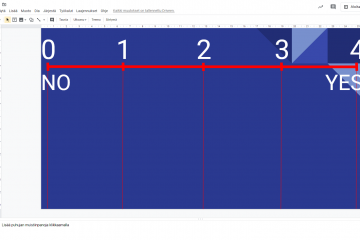
    For this part of the lesson I have prepared a slide that has a line with two scales – the upper scale has numbers from 0 to 4 and the lower one with only words “NO” and “YES”. I also have shared the file with all the students in the group for cooperation purpose (allow students to edit the file).

    At first, I will ask the students to go to our Google Classroom and find the first task including this shared slide. The students will open it and write their names in a new textbox so that they will be able to move it around the slide. After that I’ll ask one or two control questions e.g. how they feel today. The students should move their names somewhere in the slide based on their feeling today when 0 is lousy and 4 is absolutely terrific. After confirming that the idea is clear I start asking some questions about the homework and topic. Now the students will vote how clear the particular detail is or how difficult they understand certain things in homework and topic.

    By asking the right questions teachers would have possibility to spot the needs for differentiation, support, other pedagogical and didactical details around the topic.

    2. New knowledge acquisition – Google Forms Quiz

    For this part I have prepared a Google Forms Quiz including 4-6 easy and basic level exercises. The students’ task is to complete a short Google Forms Quiz independently and get an individual score for next part of the lesson. The exercises include multiple choises and a couple of open questions to make sure that the students are not just guessing the results.

    After completing the quiz, they will get the points. Based on the points the students will be given the recommended exercises from the math book. The students with 0-3 points are going to stay active at Google Meet with me and receive some extra support by going through some really basic exercises step by step. The students with 4-7 points will be assigned to do some basic-advanced exercises and the students with 8-10 points can start with more challenging exercises.

    Sometimes I have the special education teacher or the school assistant with me during the lesson. They can also help the low level group with the basic exercises while I can help the other groups and make sure their exercises to be done at right levels.

    3. Practising with the optimal level exercises based on the quiz points.

    4. Reflection – Lines (Google Classroom – Google Slides)

    The lesson will end the same way as it started – by collecting some feelings and opinions about the way of working, the level of the exercises, the adequacy of support, their own productivity and attitudes. Remember to listen to the students after every voting and ask for more detailed information so that the next lesson could serve the learning better.

  • New team member – greetings from Xiaoqing/Gracie!

    New team member – greetings from Xiaoqing/Gracie!

    Hello everyone, warm greeting from Xiaoqing – my name in Chinese means ‘green bamboo’ especially referring to one kind of bamboo species which is small but very firm 😊. My father loves nature and he gave me such name with a good wish. From now on, you could remember me as Bamboo or Gracie (my English name) in whatever way you like 😊. Yes, I’m from China and lived in different parts of China before coming to Finland for advanced education in 1998. Finland has become my second home since then which I am familiar with and love dearly.

    I have +25 years’ work experience in Finland and China mainly in public schools and international IT companies. I started my career as an English teacher for a middle-school in Chongqing, China, years later moved to Southern China to work as a class teacher, a teacher of English, Chinese and Social Ethics for 3 – 6 graders. 9 years of teaching experiences was one of the proudest periods in my working life but challenging as well in the same time. I received the title of ‘The Best Young Teacher’ and my students always achieved the top-ranking results in city-level exams while I didn’t have enough experiences, proper teaching tool as well as support from peer teachers. But thanks to creativity, passion about education and diligence, I did overcome those obstacles but with much harder ‘cost’. In my deep mind, I wished that one day all teachers would get help as they deserve in order to make teaching enjoyable as it should be so that all students would have access to better education.

    Today I am grateful for being part of LessonApp team – a group of Finnish enthusiastic educators who aim to help teacher community in the best way and most importantly work hard to achieve the goal. Facing a few good career options, finally I decided to join LessonApp because I couldn’t resist working for something with someone who touches my heart.

    Thankfully I have long-term working experience in Nokia and Microsoft in areas of R&D testing, usability, user interface, global customer care, online operation, content creation, and project management which I could utilize for helping LessonApp. I also had opportunity to work as an entrepreneur for several years in education-culture business sector before joining in LessonApp. I am dedicated to serve the whole community around LessonApp with my best knowledge and skills.

    Looking back, I am very thankful for every opportunity, work experience and different culture experiences I have had not only in China and Finland, but also in many other countries which I had chance to interact with. I learned a lot! I hope to meet many of you in my new journey with LessonApp, make friends with you and collaborate with you to achieve together in our mission ‘Make the World’s Best Education Accessible to Everyone’.

    Finally, if you are curious why I chose Finland as the first country to come two decades ago, my answer is that the Finnish pure nature, lifestyle, state of mind, and equal society got me here and kept me stay here happily.