Month: February 2019

  • Travelogue from Malta

    Travelogue from Malta

    Team LessonApp had an amazing trip to Malta in February! The core mission of our trip was to launch LessonApp Premium and our collaboration with the Ministry of Education of Malta. We also had a possibility to train teachers, visit University of Malta and meet staff and students in the Faculty of Education etc. Thank you Malta for the great collaboration!

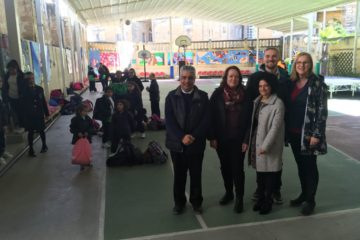
    On our day of arrival, our partner, Dr. Kenneth Vella introduced us to his school St. Joseph Mater Boni Consilii, Paola and the renewed playground

    St. Joseph Mater Boni Consilii School provided multiple engaging learning spaces and environments. Thank you for an inspiring visit!
    Tuomas Taubert and Ellimaija Ahonen went to the University of Malta, Faculty of Education to meet students and personnel. Tuomas explained the characteristics of the Finnish education system to an interested audience. Tuomas and Ellimaija also introduced LessonApp to the students and staff. Thank you for the positive and constructive feedback!
    It was our pleasure to launch the collaboration with the Maltese Ministry of Education. The Maltese primary teachers get LessonApp Premium for the end of the year 2019 Minister Evarist Bartolo receiving the certificate from Johanna Järvinen-Taubert. We thank Malta for great collaboration!
    During our visit we had a chance to introduce LessonApp to over 300 Maltese teachers. We instantly received such positive and inspiring feedback from these talented teachers.

    In LessonApp workshop participants got to try to design their first lessons with LessonApp.
    “I will definitely start using LessonApp!” “This gives so much possibilities to include warm-up and reflection to lessons!” Thank you also for the great suggestions on how to develope LessonApp further! Progress on the way… 😉
    Team LessonApp with our Maltese partner, Dr kenneth Vella. Thumbs up for the start of great collaboration!
    On Saturday 16.2.2019 it was to time to launch LessonApp Premium officially. Dr. Kenneth Vella giving the opening words.
    There was media present at the launch. Not an everyday task to talk to the TV-cameras… 😉
    Good conversations after the launch took place.
    Happy team after an excellent and inspirational trip. Thank you Malta!
  • Press release: RESOLVING THE LEARNING CRISIS WITH THE HELP OF EDUCATION TECHNOLOGY

    Press release (free to share on Feb 16th 2019)
    RESOLVING THE LEARNING CRISIS WITH THE HELP OF EDUCATION TECHNOLOGY

    Global education is in crisis. Majority of children do go to school, but the learning results are poor. Teachers in many countries are lacking quality teacher training.

    “The reality struck us when we were travelling in emerging countries to train teachers. Many of the teachers we met were doing their best, but they didn’t have the resources or skills to develop their teaching competence,” Ellimaija Ahonen, Co-Founder and CEO of LessonApp says.

    “During this era of unlimited flow of information and efficient communication technology, how is it possible, that we cannot offer basic pedagogical knowledge and tools for every teacher around the world?” Johanna Järvinen-Taubert, teacher trainer and Co-Founder of LessonApp questions. “Coming from Finland, a land of excellent learning results and a strong ethos of equality, this seemed fundamentally unfair to us.”

    To tackle this challenge, a mobile lesson planning tool for teachers called LessonApp was developed. Our group of Finnish pedagogical experts, teacher trainers and software designers believes that teachers are the game changers in the field of education, and we want to empower them.

    Team LessonApp aims to equip teachers with the understanding of the learning process and, with the tools provided by the app, to help teachers plan efficient and inspiring lessons themselves. The ultimate purpose is to offer quality education for all children and increase the joy of learning in classrooms – for both students and teachers.

    “We guarantee that everyone gets the basic version free of charge – with no time limitations. That is our contribution to solving the education crisis and sharing the good that we have. As actions speak louder than words, it is time to make a big impact with digitalization,” says CEO Ellimaija Ahonen.

    LessonApp Premium was launched on Saturday 16th February 2019 in Malta. “This pioneer collaboration with Ministry for Education of Malta provides every primary teacher an access to LessonApp Premium. We are very happy about this as well as looking forward to hearing the results and feedback,” Johanna Järvinen-Taubert summarizes.

    Finland is renowned for its education excellence, efficiency and top learning results. “During the Finnish teacher training, teacher students are taught different options and possibilities for designing lessons in a pedagogically productive way. We gathered all the knowledge we have related to learning and activating teaching methods, and packed the data into an easy-access format for mobile phones,” team LessonApp sums up.

    LessonApp is available in PlayStore, AppStore and www.lessonapp.fi/download

    Contact information:

    Ellimaija Ahonen                                                                        
    Co-Founder, CEO
    LessonApp Ltd
    Finland
    [email protected]
    +358407037337
    www.lessonapp.fi
    Twitter: @LessonApp
    Facebook: LessonAppFI
    Instagram: lesson_app

  • LESSONAPP: DEVELOPING A MOBILE LESSON-PLANNING TOOL FOR TEACHERS

    LESSONAPP: DEVELOPING A MOBILE LESSON-PLANNING TOOL FOR TEACHERS

    This article has been published in Impact: Journal of the Chartered College of Teaching, Education technology

    Authors: Johanna Järvinen-Taubert and Päivi Valtonen

    Keywords: lesson planning, learning, teaching, socio-constructivist approach


    LessonApp – developing a mobile lesson planning tool for teachers

    It seems that designing quality lessons is one of the cornerstones of teacher education in developed countries. Such is the case with Finland [1], where lesson planning plays a major role in teaching. Planning lessons beforehand is important as it contributes to enhancing learning the best possible way.

    However, this is not reality for all the teachers around the world. Teachers in emerging countries do not always have access to proper training and quality pedagogical knowledge, and therefore lack versatile manners of carrying out lessons. For many of these teachers, the only pedagogicalmodel known to them is the ‘teacher talking and students listening’model. Although teachers are doing their best, they cannot find a way to create better lessons without having knowledge of different possibilities.

    Correspondingly, teachers from countries with further-developed educational systems have different problems. Finding new ideas can be challenging even with in-depth background knowledge of learning and teaching: the problem is not the insufficient number of pedagogical methods, but the scarcity of available time. Thus, teachers are in need of user-friendly tools that help plan quality lessons and provide an easy access to new ideas and methods.

    We saw this as a challenge that could be solved by using smart technology. Indeed, it seems incomprehensible to us that during this era, a time of an unlimited flow of information and efficient communication technology, we cannot offer basic pedagogical knowledge and tools for every teacher around the world. Even in the most remote, unprivileged areas teachers very often have mobile phones. Smartphone ownership has risen substantially in emerging countries since 2015 (Poushter J, BishopC & Chwe H 2018, p. 7). Even though many teachers lack the basic resources needed for teaching, they probably still have a smartphone in their pocket. So, could we bring the teachers and the necessary knowledge and tools together in a simple form of a mobile app?

    Moreover, could the very same solution provide answers to the challenges of the teachers in developed countries, too? Could we devise an easy-to-use tool that is based on latest research on learning and provides teachers with new ideas for quality lessons?


    The socio-constructivist view on learning

    As our group had a background in teacher training, we wanted to focus on the pedagogy part: which concept of learning acts as the basis for quality lesson planning? How do we apply this learning approach to the design of a mobile tool? These were the key points of our work.

    Modern educational research has revealed many factors that promote learning: learner’s own activity, motivation, participation, collaborative learning (learning with and from each other), reflection, connections to prior knowledge, physical activity, using versatile methods etc. (Lonka 2018, pp. 28–48).

    This contemporary learning theory that has been the basis for teacher training in Finland for years is called the socio-constructivist view of learning (Lonka 2018, p. 28).

    The socio-constructivist view of learning rests on the following principles:

    • Learning is perceived as an active, notpassive, process through which knowledge is constructed by the learner.
    • Knowledge is mutually built and constructed in the social contexts of learning.
    • Prior knowledge, understanding and experiences are relevant to learning new things.
    • The teacher’s role is to support and nurture the learning process: teachers are facilitators who enable students’ development and learning. (Lonka 2018, p. 28)

    Finnish teachers base their work on the socio-constructivist view and apply it daily in various ways. The approach can manifest in many diverse ways in the classroom:

    • engaging learners in activity, discourse, and reflection
    • frequent use of discussions and participation
    • giving learners an opportunity to present their own questions and construct their own models
    • encouraging independent thinking: students test their ideas, synthesise the ideas of others, build deeper understanding of what they are learning and develop reasoning skills
    • using various activating and co-operative teaching methods. (Lonka 2018, pp. 50–57; Walker 2017)

    The socio-constructivist approach to learning not only produces excellent learning results but also promotes the acquisition of useful skills for life. The approach encourages learners to be active in constructing their own knowledge and collaborate to solve problems together with other learners. Itfosters important life skills such as self-regulation, self-determination and perseverance. The approachalso promotes collaborative skills as respectful communication, negotiating, compromising, tolerance, ability to encourage one’s teammates, appreciation of diversity, working constructively with different types of people and so on. These life skills, especially analytic reasoning, complex problem solving and teamwork are prerequisite for deeper learning.

    Furthermore, this approach to learning is useful for gaining 21st century skills such as:

    • Creativity and Innovation
    • Critical Thinking and Problem Solving
    • Communication
    • Collaboration
    • Initiative & Self-Direction
    • Social & Cross-Cultural Skills
    • Leadership & Responsibility (Partnership for 21stCentury Skills 2016).

    Students’ well-being can be increased by promoting theirown activity, participation and involvement. Student well-being is as important as the learning outcomes. A stress-free and engaging atmosphere in the classroom promotes learning and enhances the general well-being of the children, young people and teachers alike. It is possible to achieve excellent learning results and feel joy over learning simultaneously (Walker 2017, xxvii-xxix).


    Designing the mobile lesson planning tool

    We were confident that we wanted to apply this modern, research-based view of learning to the lesson planning tool we were designing. However, we were facing two major challenges:

    1. How to incorporate these basic principles – learners’ own activity, learning with and from each other, the importance of prior learning etc. – into the application in a meaningful way?
    2. How to make the users active agents in designing their lessons instead of passive receivers of pre-chosen models?

    For the first challenge, we decided to devise a tool with an easy user interface, which shows the learning-promoting actions that should be taken during lessons. We wanted teachers to have a simple instrument for planning efficient and relevant lesson structures, and thus created a tool with ‘building blocks’ which the teachers can use to plan versatile and purposeful lessons.

    The building blocks are divided into five categories according to the key elements of the socio-constructivist view on learning:

    1. Warm-up and grouping / safe atmosphere for learning
    2. Orientation and mapping pre-existing knowledge / what learners already know about the matter
    3. Acquiring new information / constructing one’s own knowledge
    4. Practising / learners being active themselves
    5. Reflection / learners deepen their learning via conscious thinking processes

    Each building block represents a phase or a function of a lesson. The idea is to construct lessons by usingthese blocks according to the goal of the lesson: not all blocks are necessary in each lesson, and their order can vary depending on the purpose and objective of the lesson.

    Furthermore, we wanted to give teachers abundant different practical ways to actually put these key principles into practice and carry out lessons based on them. We therefore included over 100 different activating, collaborative and reflective teaching methods to the app. Each method is specifically dedicated to these certain building blocks, i.e. functions or phases of a lesson.


    The second challenge – how to make the users active agents in designing their lessons – was crucial for us.It would have been possible to cater ready-made models for the teachers to apply, but it would have rendered them passive receivers instead of active actors, which would have strongly contradicted the principles of the socio-constructivist view on learning in addition to undermining the creativity and talent so many teachers have. We believed that creating an easy-to-use lesson planning tool would give teachers unlimited possibilities to create better lessons for their students – better than we could ever have created. Coming from a certain culture, history and background, we can never know what kind of lessons would be the most beneficial for learners in a completely different context. Yet, the local teachers have all the necessary knowledge of the situation of their own school and their own students.

    What we can do, however, is provide teachers with tools that are scientifically proven to promote learning and let them use these tools the best way they can. To summarise, we wanted the teachers to have a better understanding of the learning process and how to plan efficient and inspiring lessons themselves. We wanted them to have the latest knowledge ofthe factors that in fact promote learning, and therefore included a short introduction to modern, research-based pedagogy to the app (explained in short videos).

    In addition, we wanted the teachers to be able to share their ideas and learn from each other. To incorporate the collaborative learning approach, we decided to include the possibility of sharing one’s own lesson plans and to browse the database of other users’ lesson plans.


    LessonApp – quality education for children

    Every child has a right to an education of a good quality, and we think that teachers are at the heart ofquality education. This led us to design an application that helps teachers plan versatile and high-quality lessons for children and young people.

    LessonApp will be launched later this year, and we hope it will provide help for many teachers around the world. We want every teacher to feel competent and for the children to experience the joy and flow of learning.

    [1] Lesson planning is based on the latest scientific research on learning and how to foster it the best possible way. It is vital that the teachers-to-be get astrong foundation of what is learning and how to promote it. Achieving a versatile ‘toolbox’of different methods and pedagogical practices for choosing the best possible pedagogical solution for different groups and situations is also essential. (Lonka 2018; Sahlberg 2015.)

    References
    Lonka K (2018) Phenomenal learning from Finland. Helsinki: Edita.

    Partnership for 21stCentury Skills (2016) Frameworkfor 21stCentury Learning. Available at: http://www.p21.org/storage/documents/docs/P21_framework_0816.pdf(accessed 20 September 2018).

    Poushter J, Bishop C & ChweH (2018) Social Media Use Continues to Rise in Developing Countries but Plateaus Across Developed Ones. Pew Research Center. Available at: http://www.pewglobal.org/2018/06/19/2-smartphone-ownership-on-the-rise-in-emerging-economies/ (accessed 19 June 2018).

    Sahlberg P(2015) Finnish lessons 2.0. What can the world learn from educational change in Finland? New York: Teachers College Press.

    Walker T (2017) Teach like Finland. 33 Simple strategies for joyful classrooms.New York: W.W.Norton & Company.