
Category: Teaching

  • Free webinar: Practical STEAM examples from Finland

    Free webinar: Practical STEAM examples from Finland

    Join our upcoming free webinar “Practical STEAM examples from Finland ” on Tuesday 9th June at 1:00 PM GMT.

    Discover how to bring STEAM and sustainability meaningfully into your teaching. This session explores how the national curriculum can provide a strong foundation for interdisciplinary learning that prepares students for the future. STEAM education expert and trainer Sari Hirvasniemi, will introduce practical approaches to STEAM education and sustainability, sharing inspiring ways to integrate interdisciplinary learning, creativity, and real-world problem-solving into everyday teaching.

    You will gain a clear understanding of how to plan effective STEAM projects, from initial ideas to practical implementation in the classroom. The webinar also introduces a project, offering a concrete real-world example of how STEAM principles can be used to create sustainable solutions. Through this case, participants will see how theory connects with practice and how students can engage with authentic, impactful challenges. In addition, the session focuses on assessment, providing practical strategies for evaluating STEAM projects. Special attention is given to creativity, which plays a central role in innovation and problem-solving. You will learn how to recognize, support, and assess creativity in student work. This webinar offers both inspiration and practical tools, helping educators foster creativity, critical thinking, and sustainability awareness in their classrooms while confidently guiding students through engaging STEAM learning experiences.

    A recording will be available for a limited time if the time zone doesn’t work for you. Warmly welcome!

    Sign up here for online webinars!

  • Free webinar: Inclusion in Finnish education

    Free webinar: Inclusion in Finnish education

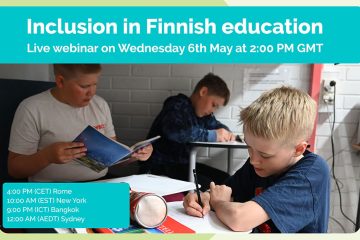
    Join our upcoming webinar “Inclusion in Finnish education” on Wednesday 6th May at 2:00 PM GMT.

    Inclusion is a widely discussed topic in modern education, yet its practical implementation often remains a challenge. We invite you to a free webinar exploring how to make inclusion work effectively through structures and practical solutions at the school and classroom levels. Learning Scoop’s expert and trainer, Anna Haukkala, will introduce the Finnish system of educational support and share practices that strengthen inclusion in everyday school life.

    A recording will be available for a limited time if the time zone doesn’t work for you. Warmly welcome!

    Sign up here for online webinars!

  • Free webinar: Education for Sustainable Development

    Free webinar: Education for Sustainable Development

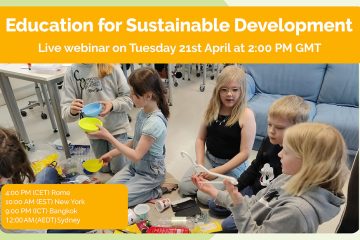
    Join our upcoming webinar, “Education for Sustainable Development,” on April 21st at 2:00 PM GMT.

    How could schools take part in sustainability transformation in society? Education for Sustainable Development (ESD) is crucial as it equips individuals with the knowledge, skills, attitudes, and values needed to create a sustainable future. However, many teachers struggle to effectively integrate sustainability into their teaching. Learning Scoop’s sustainability specialist and trainer, Anna Haukkala, will host a free webinar. Anna will discuss the importance of ESD, its implications for teaching, and how to incorporate it into educational practices.

    A recording will be available for a limited time if the time zone doesn’t work for you. Warmly welcome!

    Sign up here for online webinars!

  • Free webinar: Cornerstones of Finnish Education

    Free webinar: Cornerstones of Finnish Education

    Join out upcoming webinar Cornerstones of Finnish Education on January 29th 2026 at 2:00 PM GMT. Our pedagogical director Johanna Järvinen-Taubert will share insights of the key points of Finnish education: stress-free approach, equality and equity, trusting the teachers etc. Jump in and find out what makes Finnish education so special!

    Recording available for a limited time if the time zone doesn’t work for you. Warmly welcome!

    Sign up here for online webinars!

  • Free webinar: Cornerstones of Finnish Education

    Free webinar: Cornerstones of Finnish Education

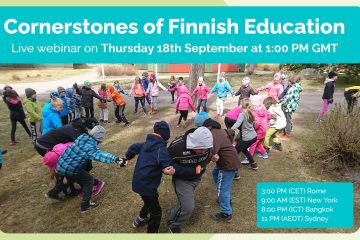
    Join out upcoming webinar Cornerstones of Finnish Education on Thursday, 18th September at 1:00 PM GMT. Our pedagogical director Johanna Järvinen-Taubert will share insights of the key points of Finnish education: stress-free approach, equality and equity, trusting the teachers etc. Jump in and find out what makes Finnish education so special!

    Recording available for a limited time if the time zone doesn’t work for you. Warmly welcome!

    Sign up here for online webinars!

  • Principals developing operational culture at school

    Principals developing operational culture at school

    Culture is defined as the learned beliefs, values, rules, norms, symbols, and traditions that a group of people shares. The group that shares these qualities makes them unique“ (Northouse 2007, Leadership theory and practice).

    According to the national core curriculum in Finland, the school culture plays a key role in implementing comprehensive basic education and thus always affects the quality of school work experienced by the pupils (National core curriculum for basic education 2016).

    The operational culture is an entity which consists of several components:
    • interpretation of the norms that direct the work and the goals of activities
    • leadership and the organization, planning, implementation and evaluation of work
    • competence and development of the community
    • pedagogy and professionalism
    • interaction, atmosphere, everyday practices and learning environments.

    (National core curriculum for basic education 2016.)

    Changing the present operational culture may be the most important and at the same time the hardest task when dealing with the development of the school. Organizations tend to be conservative, traditional by nature and usually they encourage to use strategies that strengthen the present state of issues.

    Furthermore, teachers are very different according to their age, experience, mindset, education and preferences. How to fit them smoothly together in the same school? Creating a shared operational culture becomes the key issue.

    Developing operational culture is about creating shared, constructive meanings. People create meanings, either consciously or subconsciously, about different occurrences around them. When these meanings are mutual and mainly positive by nature, it becomes easier for the individuals to act and collaborate together. Shared knowledge will rise from the network of interpretations which is based on many personal things but mainly on the present culture. The longer people immerse themselves in the culture, the more invisible it becomes. To put it simple: The more positive, open and flexible operational culture, the more constructive meanings will be selected.

    Principals have an important role in creating and developing an operational culture at school. Principals can, through their own behaviour and actions, influence the school’s operational culture. Even though operational culture can be a complex phenomenon and concept, it can be affected in many simple ways. As a principal, these are some of the practical actions worth paying attention to:

    1. Being an example
    2. Noticing individuals and listening
    3. Reacting to teachers’ initiatives and taking action
    4. Fostering openness

    Tommi Roininen
    Principal
    Pitkäjärvi Junior High School (grades 7–9)
    Kangasala, Finland

  • Grit predicts school achievement

    Grit predicts school achievement

    Sisu will get you even through granite” is a popular Finnish saying. The concept of sisu has no direct translation. It is inner strength, determination, and perseverance. An essential element of sisu is high persistence despite the difficulties and setbacks. Maybe the closest word to sisu is grit.

    A longitudinal study funded by the Academy of Finland shows that grit in the early age predicts school achievement and engagement later. The “Bridging the Gaps” project studied for the first time the formation of grit and its meaning for adolescents’ school engagement and academic success. The research group studied about 2000 students from Helsinki, Finland. Students were followed four years, through their education path from sixth grade until the end of ninth grade.

    According to the “Bridging the Gaps” study grit is not seen as a personality trait. Instead, grit transforms and develops during adolescence. Perseverance and grit can also be learned. Learning grit is possible, for example, by challenging oneself. Challenging oneself is actually more important than success or failure that follows. Possible mistakes are a valuable part of the learning process; at its best mistake is an opportunity to learn and develop. School should be an arena where it is safe for children and adolescents to try, fail and learn to cope with setbacks.

    Another way to promote grit is setting goals and committing to them. The “Bridging the Gaps” study states that the factor that best predicts grit is commitment to goals. If students lack commitment, they will not be able to make the most of grit. Students should establish goals for themselves, and teachers should support students in their commitment to the goals. According to the researchers: “Helping adolescents to set and develop a proper long-term goal on education and providing the supportive environment to achieve that goal may increase their level of grit, and in turn, promote adolescents’ engagement and achievement in the school.

    Adolescents’ thinking tends to be very concrete, and it is often focused on the present. For them immediate rewards are much more attractive than long-term benefits or consequences. This is typical for young people, and we adults and educators should accept this as a fact. What we can do is encourage adolescents to long-term, future thinking instead of short-term thinking, support them in their commitment to the goals, and stand by them.

    It is also important to recognize and support young people’s strengths. Positive education aims at making strengths, such as self-regulation, compassion, gratitude, grit, perseverance and so on, visible in every learner. Noticing and building on strengths can help children and adolescents to thrive.

    Author: Päivi Valtonen, Pedagogical expert, Co-founder of LessonApp


    Reference:
    Tang, Xin, Wang, Ming-Te, Guo, Jiesi & Salmela-Aro, Katariina 2019. Building Grit: The Longitudinal Pathways between Mindset, Commitment, Grit, and Academic Outcomes. Journal of Youth and Adolescence 5 (48), 850–863.

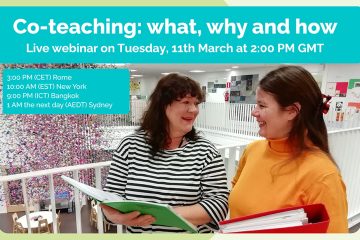
  • Free Webinar: Co-teaching: what, why and how.

    Free Webinar: Co-teaching: what, why and how.

    We are running a series of webinars once a month. Join our upcoming webinar,
    Co-teaching: What, Why, and How” on Thursday, March 11th at 2:00 PM GMT.

    Have you explored the benefits of co-teaching? In this upcoming webinar, we will dive into how co-teaching can support teachers and enhance the learning experience in schools. With practical examples, we’ll look at various ways to implement co-teaching effectively. PhD Kati Keski-Mäenpää will lead a free webinar on “Co-teaching: What, Why, and How” on March 11th at 2 PM GMT.

    Are you curious about how co-teaching could transform your classroom? Don’t miss out!

    Recording is available for a limited time, if the time zone is not doable for you. Warmly welcome!

    Sign up here for online webinars

  • Designing lessons with LessonApp: The difference between science and pseudoscience (high school philosophy)

    Designing lessons with LessonApp: The difference between science and pseudoscience (high school philosophy)

    Author: Johanna Järvinen Taubert

    In the Finnish general upper secondary school (high school) curriculum, philosophy is one of the mandatory subjects. Philosophy is not only seen as part of the shared, cultural knowledge everyone should have an understanding of, but also a way to develop much needed thinking skills. Studying philosophy develops judgement and promotes the development of critical, creative and independent thinking. Philosophy supports the students in forming justified, independent views and their ability to participate in rational discussion.

    Essential part of the studying philosophy is to learn critical thinking. It is vital that students will learn to investigate the arguments presented to them, formulate and justify their own views, and to respect other reasoned views. Studying philosophy supports the students’ growth into active and responsible citizens with respect for one another.

    When teaching philosophy, I consider encouraging students’ own thinking, logical argumentation and rational, respective conversation to be the most important goals.

    In the Finnish national core curriculum for high schools (general upper secondary schools), there is compulsory philosophy course called Introduction to philosophical thinking. One of the objectives of the course is that the student “learns to evaluate the truthfulness of statements and develops skills in presenting and demanding justifications for different opinions and statements as well as perceiving the structure of presented justifications and evaluating their validity”. One of the core contents of the course is “the difference between knowledge and information, practical and scientific knowledge, and science and pseudoscience”.

    The topic of my lesson is “The difference between science and pseudoscience”. During this lesson we start to investigate the difference between science and pseudo-science. The length of this lesson is 75 minutes, which is the typical length of lessons in Finnish high schools. I’ve used LessonApp Premium to plan this lesson. You can find the whole plan and more detailed method discriptions in LessonApp. (download LessonApp here)

    1. Orientation to the topic (20 min)

    Method used: Lines

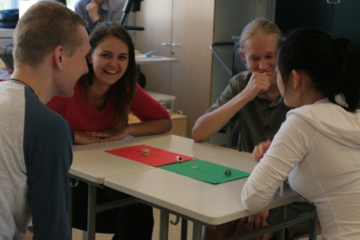
    Students are divided into groups of 4 by using cut postcards.

    There is a line marked on the students’ school desks by tape with two extremities. One end of the line is “Scientifically-proven”, the other “Pseudo-science, not proven scientifically”.

    Students get a set of arguments they face often in news or social media. Students must consider, if they think this statement is scientifically-proven or not (more like pseudo-science) or something in between and position their view on the line accordingly. Students place their pen or some other small item on their chosen position on the line and then discuss together, why they think this argument is scientifically-proven, pseudo-science or something in between. If they hear an argument that changes their view on the topic, they can change their position on the line. The goal of this exercise is to orientate students to the topic: to encourage them to think, how do we know, if arguments often presented in media are scientifically-proven or just beliefs. The exercise also aims to help students to learn to recognize trustworthy arguments and to carefully listen and analyze arguments presented by others.

    2. Aquiring new information 45 min

    Method used: Jigsaw (applied)

    Teacher will give a small introduction (5 min) of the debate between science and pseudo-science: how it is seen in our society, why is it relevant etc. Teacher will also explain the purpose of the next exercise: to help students to understand the fundamental differences between science and pseudo-science and to be able to investigate, if some arguments and theories are scientifically valid or not.

    The groups of four used in the previous exercise are now divided into two (two students in each group). Half of the groups are “red teams”, half of the groups are “blue teams”. Red and blue teams have different tasks:

    Red teams: Students find characteristics of scientific reasoning, arguments, theories and research

    Blue teams: Students find characteristics of pseudo-science, and how to recognize the pseudo-scientific arguments.

    Resources: own text book / digital learning material, useful links provided by teacher, newspaper articles

    All teams prepare a poster of the most important points of their topic.

    Here are some questions to help the teams to gather meaningful information:

    Red teams

    • What are scientific principles and method?
    • What is characteristic to scientific method?
    • How are scientific results produced and proven?
    • How are hypothesis developed and tested?
    • What is falsifiability of claims?
    • What is the role of controlling or boundary conditions in scientific theories?
    • What is the role of scientific community and peer review in evaluation of research results?
    • How does science evolve? What does self-correction mean?
    • Are scientific results absolute?

    Blue teams

    • What is the definition of pseudo-science?
    • What is characteristic to pseudo-science?
    • How is information gathered and examined, how are hypothesis developed and tested?
    • What does confirmation bias mean?
    • What is the stand for openness to evaluation by other experts?
    • What is the role of controlling or boundary conditions?
    • What is the role of confirmation and refutation?
    • What is the role of testimonial, anecdotal evidence, or personal experience?
    • What kind of progress or evolution is seen in the theories?
    • Give examples: what has been characterized as pseudo-science?
    • Why some people find the term pejorative?

    After gathering relevant information and making a poster, one red team and one blue team get together. Teams teach their contents of their poster to an other team. Groups of four discuss together, what are the major differences between scientific knowledge and pseudo-science.

    Goal of this exercise is to learn, how to recognize the fundamental differences between science and pseudo-science: how information is gathered, hypothesis and theories tested, what is their response to openness, refutation and critical investigation, how is the information / knowledge evolving etc.

    3. Reflection (10 min)

    The whole class will have a reflection together with the teacher. The class will reflect:

    • What did you learn today?
    • What was difficult / unclear?
    • What would we still like to learn more about?

    On the next lesson, groups will examine one case example more closely. Some of the cases are considered science-based and some pseudo-science. Groups choose one topic to study more closely. Teacher provides some case examples (like anti-vaccine movement, homeopathic remedies, healthy diet recommendations, astrology, evolution theory etc.), but students are free to choose their own example as well. At the end of the lesson each group decides their own topic and the homework for the group is find information about this case example and why it is considered either science-based or as pseudo-science. Following questions should be evaluated:

    • How do they justify their beliefs? What are the logicalmethodological, or rhetorical bases of the topic in question?
    • Are their signs of poor scientific reasoning? If so, what kind of?
    • What kind of practical or societal implications there are, if a theory is considered either scientific or pseudo-science?

    You will find the whole lesson plan in LessonApp.

  • Activating methods in classroom

    Activating methods in classroom

    A teacher stands in the front of the classroom and talks. Students are listening, maybe taking notes. After the lecture students might do some exercises in their textbooks. Sounds familiar?

    This model of teaching in which a teacher pours information to students and students’ role is just to listen and sit still, is an old school method. Sometimes there is a place for this way of teaching as well, but if this is the only teaching method in the class, skills in learning and collaboration will become narrow.

    Let’s think about the modern society and its requirements for individual´s skills in working life

    How is the traditional way of teaching related to the requirements of modern society and working life? Let’s imagine the situation: a person goes to a job interview, and will be asked “What are you good at?” Will they answer: “I am very good at listening and sitting still”?

    The society and working life require that a person is able to negotiate, collaborate and learn themselves. These skills develop through everyday life, beginning already in the childhood. It is important that these skills are being practiced at school as well.

    Moreover, researchers have pointed out that activating learning methods can be more efficient way of learning than the traditional ones. Activating methods increase pupil´s involvement, motivation and attention but also develop certain cognitive aspects better than traditional teaching. Activating methods develop skills in analysis, synthesis, and evaluation. Also, activating learning methods increase helpfulness, empathy and other social skills.

    But how is it done?

    Students of different ages need different methods. Even the pre-primaries benefit from activating methods and it is very important to start early: variations in methods create a rich learning environment. Even the traditional teaching is only one part of classroom activities, but it still has an important role in creating calmness and safety in classroom.

    The first small step you can take is to make a traditional lesson more engaging. A traditional lesson can be activated with small plays, games and discussions. Sometimes adding more involvement to a lesson is about creating small “buzz groups”. Students´ discussions and conversations create new information, help assessing prior knowledge and solving tasks. LessonApp, a Finnish mobile app for designing lessons, is a treasure box for all my favourite activating methods. LessonApp offers many ways to use these methods in different subjects and with various age groups.

    Co-operative learning is one of my favourite methods. Here is one example of co-operative learning: students work in teams of 4 or 5, and every student has been given a role: a leader, a secretary, an observer, an encourager, an organizer. The roles and tasks are told and learned. The teams work together with given topic during the lessons. The co-operative learning team can also be used in other situations during the school day: e.g. leader is the one who takes care of leading his/her team outdoors or to wash hands. The roles in the team change every day, so everyone has a chance to act in every role. This method is excellent with every age group, from pre-primaries to adults. Believe me, this has been tested!

    On the next level, activating methods encourage a teacher to abandon the notebooks: they are not always relevant in learning and assimilating new information. New things can be studied in learning labs and workshops. In addition, new digital environments guide through learning and a teacher can be a supportive mentor instead of an information pouring character. New learning environments can also be found in school’s hallways, gym halls and especially outdoors. School hunt is an excellent method for learning outside the classroom. It combines learning with physical movement and can be used in math, languages, science, history, religion etc. Detailed instructions for school hunt can be found in LessonApp.

    Buzz groups and school hunts are examples of easy, quick methods. They give inspiration and engagement for student´s learning even in a short time: buzz groups can last only 5-15 minutes of a lesson; school hunt takes 1-2 lessons. An example of a longer lasting activating method is project-based learning.

    It is good to remember that not all methods suit every class

    The self-directed learning and projects can be very difficult for a child who has problems for example in directing attention and self-control. They usually need very structured routines. They may struggle too much with long term, unprompted projects. Small engaging activities like buzz groups suit everyone and surprisingly, co-operative learning method with given roles help also kids with special needs to participate.

    Learning by doing is an old way of teaching, this wheel was invented a long time ago. Researchers have studied this for decades: human beings learn more, deeper and better, if they can DO.

    Author: Kaisa Tuomarla
    Class Teacher, Pedagogical Specialist

    References/articles/researches:
    Binek-Rivera & Mathews, 2004
    Bonwell & Eison, 1991
    Guthrie & Cox, 2001
    Stewart-Wingfield & Black, 2005
    Anderson & Krath-wohl, 2001
    Bloom, Engelhart, Furst, Hill & Krathwohl, 1956
    Bonwell & Eison, 1991; Hackathorn, et al., 2010
    Donovan, Bransford, & Pellegrino, 1999
    Driscoll, 2002
    Rubin & Hebert, 1998
    Serva & Fuller, 2004